

Teaching the French imparfait can sometimes feel like a battle between conjugation practice and actually getting students to use the tense. It’s important to have a lot of French imparfait practice activities in our toolkit to reach a variety of different learning styles.
Students need to know how to form the imparfait, of course. But once they understand the formation, they need plenty of opportunities to use it in context. That’s where speaking, writing, games, and personal connections can make a big difference.
The imparfait is often used to talk about repeated or habitual actions in the past. If you need a quick refresher on the different uses of the imparfait, this overview of the French imparfait is a helpful reference.
Here are five ways to give your students more meaningful practice with the French imparfait.
1. Talk About Childhood
One of the easiest ways to make the imparfait meaningful for students is to connect it to their own lives.
The topic of childhood naturally lends itself to the imparfait:
- Quand j’étais petit(e)…
- Je jouais…
- J’aimais…
- Je regardais…
- Je faisais…
- Nous allions…
Give students questions about what they used to do, what they liked, where they lived, or what they were like when they were younger.
For example:
Quand tu étais petit(e), qu’est-ce que tu aimais faire ?
Où habitais-tu ?
Quels jeux aimais-tu ?
Quelle était ta matière préférée à l’école ?
Students can first write a few answers and then use them for partner conversations.
This gives them a reason to use the imparfait instead of simply filling in verb endings.
2. Use Pictures as Speaking Prompts
Pictures can be a great way to get students using the imparfait without giving them a list of verbs to conjugate.
Show students a picture of a family, a classroom, a house, a park, or another familiar setting. Ask them to describe what they see.
You can start with simple questions:
Qu’est-ce que tu vois?
Comment était la maison?
Que faisaient les personnes?
Quel temps faisait-il?
For stronger students, ask them to create a short description of what was happening in the picture.
This works particularly well for practicing the difference between description/background information and specific completed actions.
3. Combine Speaking and Writing
Students don’t always need to choose between a written activity and a speaking activity.
Try having students write several sentences using the imparfait and then use those sentences as the basis for a conversation.
For example, students could write about:
Quand j’étais petit(e)…
- où ils habitaient
- ce qu’ils aimaient
- ce qu’ils faisaient après l’école
- leurs activités préférées
- leurs amis
- leur famille
After writing, have students work with a partner and ask follow-up questions.
This gives students a little preparation time before they have to speak, which can make oral communication much less intimidating for students who aren’t confident speaking French spontaneously.
4. Play Games That Require Students to Use the Imparfait
Games can give students a reason to repeat the same structures without feeling like they’re doing another worksheet.
For example, you could have students roll a die and answer a question based on the number they roll. Or give them a set of questions and have partners take turns asking and answering.
Another simple option is an imparfait guessing game.
One student describes something from their childhood using the imparfait while the other students try to guess what they’re talking about.
For example:
J’y allais souvent avec ma famille.
Je jouais avec mes amis.
Il y avait beaucoup d’arbres.
What is it?
The goal isn’t necessarily to make the game complicated. The important part is that students are using the imparfait repeatedly and communicating with one another.

5. Practice Imparfait vs. Passé Composé in Context
Once students know both tenses, it’s important to give them opportunities to see how they work together.
Instead of asking students to simply choose between imparfait and passé composé in isolated sentences, give them a short situation or story.
For example, students can describe what was happening when something else occurred:
Je regardais la télévision quand mon téléphone a sonné.
Or have them write about a childhood memory that includes both background information and specific events.
This helps students start thinking about why a particular tense is being used rather than simply looking for a grammatical clue.
Make French Imparfait Practice More Communicative
The imparfait takes time to become comfortable. Students need repeated exposure, but that practice doesn’t always have to mean another page of conjugation exercises.
A combination of grammar practice, speaking, writing, games, and contextual activities can give students more opportunities to use the tense in different ways.
If you’re looking for ready-to-use activities to add more practice to your French imparfait unit, I’ve put together a collection of French imparfait activities that includes speaking, writing, vocabulary, grammar practice, games, and more. It’s designed for intermediate Core French, FSL, and French immersion students.
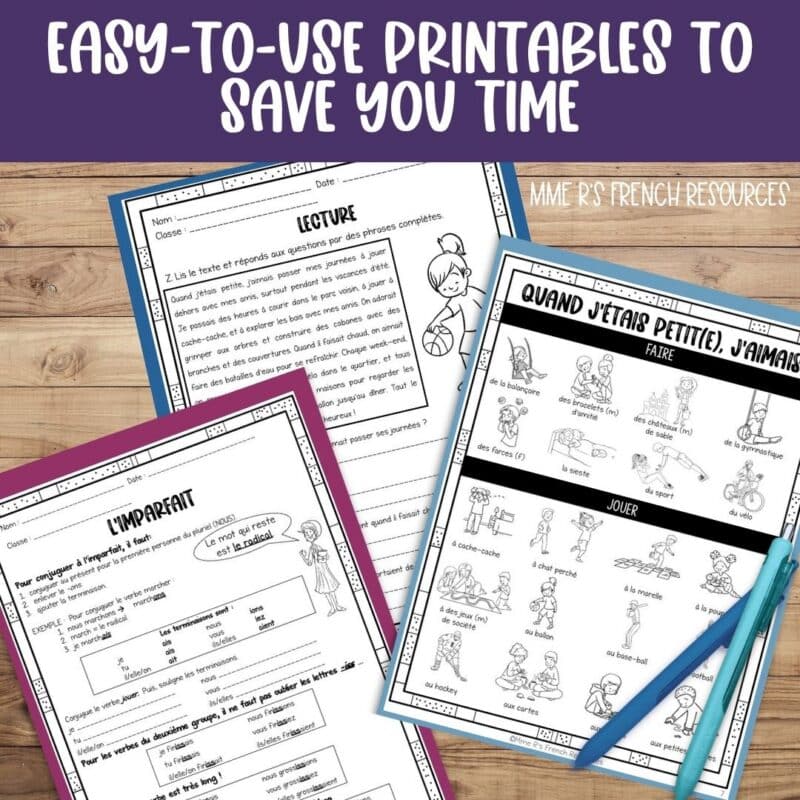
Find the activities here:
French Imparfait Activities for Intermediate French Students
The goal is simple: help students move from “I know how to conjugate the imparfait” to “I can actually use the imparfait when I communicate in French.”


