Are you wondering how to teach the passé composé? Learning all the rules of the passé composé can feel like a lot for French students, and that can make our jobs as French teachers that much more challenging!
First, they need to understand that they are forming a past tense with two parts. Then come the auxiliary verbs, past participles, irregular verbs, negation, être verbs, and agreement!
No wonder students sometimes feel overwhelmed.
The good news? You don’t have to teach everything at once.
Breaking the passé composé into smaller, manageable steps can help students understand how the pieces fit together and give them plenty of opportunities to practice before they’re expected to use the past tense independently.
Here is the approach I like to use when teaching the passé composé in Core French, FSL, and French immersion classrooms.
1. Start with the big picture
Before getting into conjugation charts and exceptions, make sure students understand what the passé composé is used for.
Connect it to things they already know how to talk about. What did they do yesterday? What did they do last weekend? What happened on vacation?
For example:
- J’ai regardé la télé.
- J’ai écouté de la musique.
- J’ai joué au tennis.
- J’ai mangé au restaurant.
- J’ai visité Montréal.
The goal at this stage isn’t perfection. It’s helping students recognize that the passé composé allows them to talk about completed actions in the past.
2. Teach the basic formula
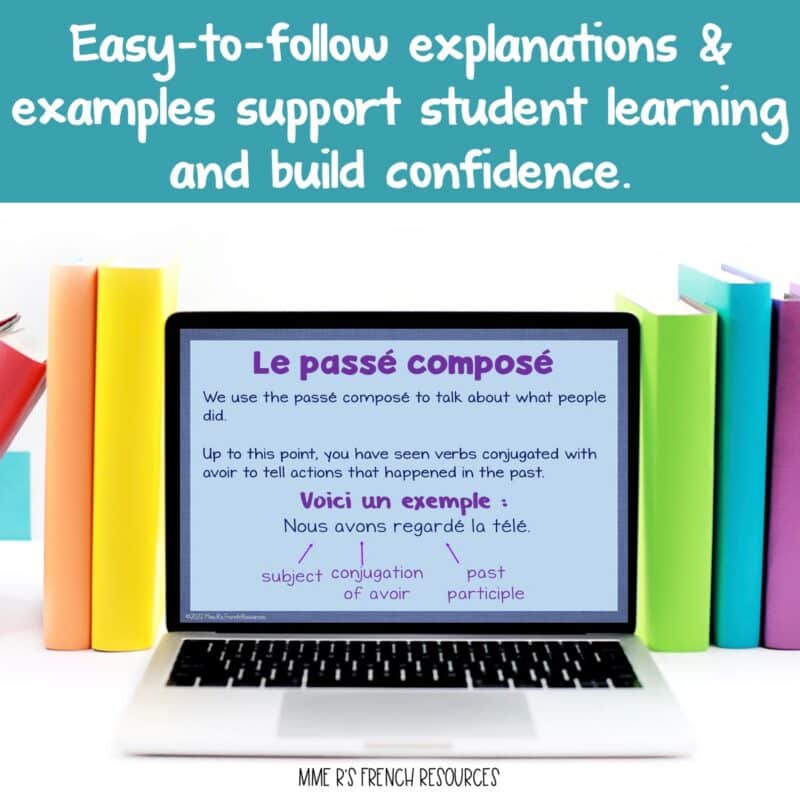
Once students understand the purpose of the tense, introduce the basic structure:
subject + auxiliary verb + past participle
For example:
J’ai + mangé.
Nous avons + joué.
Elle a + regardé.
I find that giving students a simple formula they can refer back to makes the passé composé much less intimidating.
You can then spend time practicing the two pieces separately before asking students to put them together. Need to review a little yourself before teaching it? I like how the passé composé rules are broken down here.
3. Focus on avoir verbs first
Because they are the most simple and there are so many to work with, it makes sense to begin with verbs that use avoir.
Start with familiar regular verbs and have students practice forming the past participle.
For example:
- parler → parlé
- finir → fini
- vendre → vendu
Give students plenty of opportunities to build short sentences before adding more complicated rules.
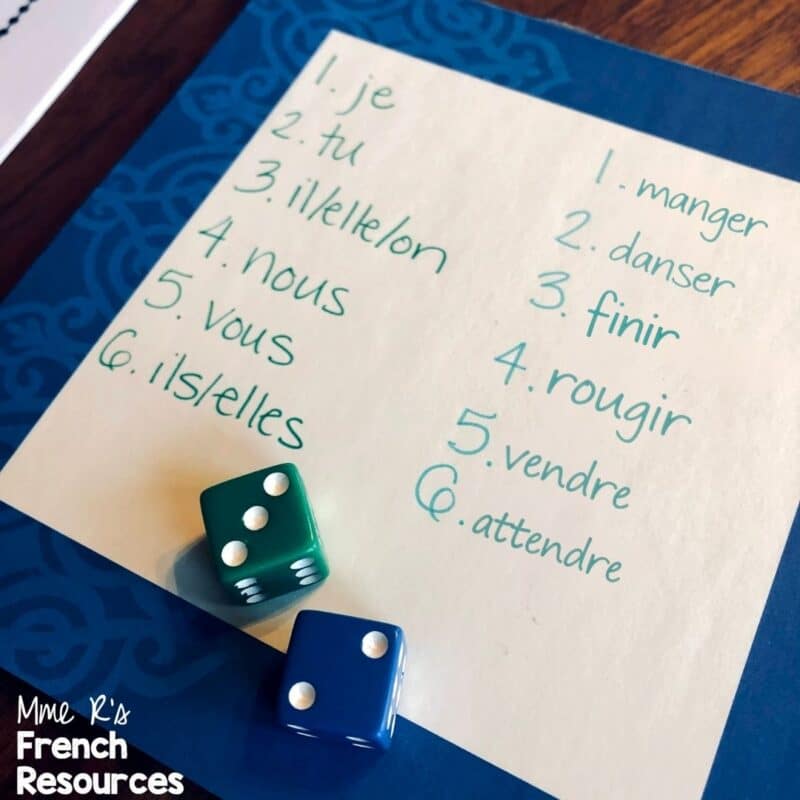
This is also a great time to use quick oral practice. Give students a subject and a verb and have them produce a sentence in the passé composé.
Teacher: Nous / jouer
Students: Nous avons joué.
Simple activities like this can give students a lot of repetition without feeling like another worksheet. You can practice verbs with a fun dice game like this one to help them get used to using them orally.
4. Introduce irregular past participles
Once students are comfortable with the basic structure, it’s time to tackle irregular past participles.
This is often where students begin to struggle because they can no longer rely on a simple pattern.
Instead of giving students a huge list to memorize all at once, introduce the most useful irregular forms gradually and give students repeated opportunities to see and use them.
For example:
- avoir → eu
- être → été
- faire → fait
- prendre → pris
- mettre → mis
- voir → vu
- boire → bu
Encourage students to keep a reference sheet or personal list of irregular forms they can consult during practice.
The goal isn’t simply memorization. Students need to see these verbs used in context.
5. Add être verbs
Once students have a solid foundation with avoir, you can introduce verbs that use être.
This is where things can get a little more complicated because students now have another auxiliary to remember—and they also need to pay attention to agreement.
Start by making the structure clear:
subject + être + past participle
Then introduce agreement with plenty of examples.
For example:
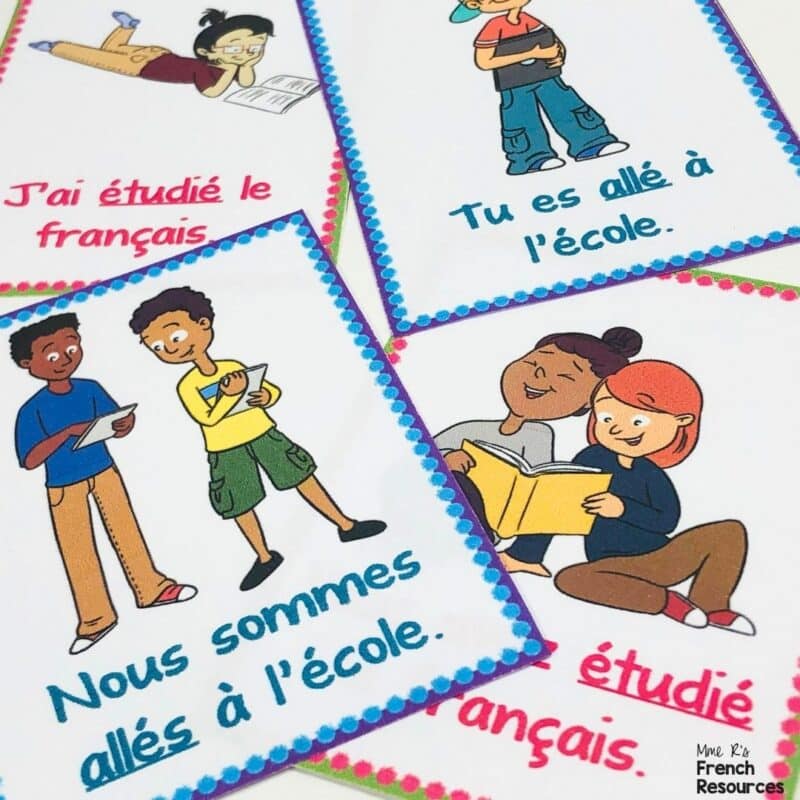
Il est allé.
Elle est allée.
Ils sont allés.
Elles sont allées.
Give students lots of opportunities to notice what changes and explain why it changes.
Visual examples and color-coding can be especially helpful here. Using a maison d’être chart or mnemonics like Dr. Mrs. Vandertramp are great for memorizing the être verbs.
6. Practice one skill at a time
One of the biggest mistakes we can make when teaching the passé composé is asking students to practice everything at once.
If students are simultaneously trying to remember:
- which auxiliary to use
- how to conjugate the auxiliary
- how to form the past participle
- whether the verb is irregular
- whether agreement is required
- where to put the negative
…it can quickly become too much.
Instead, give students focused practice.
One activity might focus only on choosing avoir or être.
Another could focus on forming irregular past participles.
Another might have students practice agreement.
Once students are comfortable with each skill individually, you can combine them. Using individual whiteboards are a great way to check for understanding. You can quickly and easily see how they are progressing, and it will provide them with written practice that feels more like a game (and you can even make it a game by dividing the class into groups and having them race!)
As they are practicing throughout the unit, these French songs with the passé composé can put the verbs in a meaningful context.
7. Don’t forget speaking practice
Grammar practice doesn’t have to stay on paper.
Students need opportunities to actually use the passé composé to communicate.
Try questions such as:
- Qu’est-ce que tu as fait hier?
- Qu’est-ce que tu as mangé?
- Où es-tu allé(e) pendant les vacances?
- Qu’est-ce que tu as regardé récemment?
- Qu’est-ce que tu as fait le week-end dernier?
You can also turn these into partner interviews, class surveys, speed conversations, or quick “find someone who…” activities.
The more students use the passé composé to talk about things that are meaningful to them, the less likely the tense is to feel like a collection of grammar rules.
8. Build in a lot of review
The passé composé is not a “teach it once and move on” concept.
Students need to encounter it repeatedly throughout the year.
A five-minute review at the beginning of class can be enough to keep those skills fresh.
You could:
- Give students three verbs to put into the passé composé.
- Display a sentence with an error for students to correct. (I LOVE this for a quick way to break some habits of immersion students, too!)
- Ask a quick question about yesterday.
- Have students translate one sentence.
- Give students a subject and verb and have them create a sentence.
- Use a quick speaking prompt with a partner.
- Put up a picture series and have them write a sentence for each picture.
These small moments of review can make a big difference when students eventually need to use the passé composé independently.
9. Mix grammar practice with communication
Worksheets have their place, especially when students are first learning how to form the tense. However, once students understand the mechanics, it’s important to help them move beyond isolated sentences.
Have students write about a past experience, interview a partner, describe what they did over the weekend, create a short story, or talk about a memorable vacation. They don’t yet know the imparfait, so long storytelling isn’t going to happen yet!
Your goal right now is short narratives:
J’ai fini mes devoirs après l’école. Puis, je suis allée au parc avec mes amis. On a joué au football et après, tout le monde est allé au cinéma.
This is where students start to see why they’re learning the passé composé.
Grammar practice gives them the tools. Communication gives them a reason to use those tools.
Make teaching the passé composé easier
Teaching the passé composé takes time, repetition, and plenty of practice, but you don’t have to create every activity yourself.
When I’m planning a passé composé unit, I like having a variety of materials available so I can move between direct instruction, guided practice, independent work, review, and speaking activities depending on what my students need.
That’s exactly why I put together my French Passé Composé Bundle.
It brings together a collection of ready-to-use resources that you can use throughout your unit—from introducing the grammar and practicing verb forms to reviewing skills and getting students speaking.
Instead of spending your planning time creating a new activity every time your students need more practice, you can choose the resource that fits the lesson you’re teaching.
With ready-to-go presentations and no-prep worksheets, it includes everything needed to teach the essentials of the passé composé. If you’re struggling with how to teach the passé composé, this bundle will give you the structure and tools you need to break it down into easy to understand chunks.
Explore the French Passé Composé Bundle
A simple way to structure your unit
If you’re planning your passé composé unit, here’s a simple progression you can follow:
Step 1: Introduce the passé composé and when to use it
Step 2: Practice the basic avoir structure
Step 3: Practice regular past participles
Step 4: Introduce common irregular past participles
Step 5: Introduce être verbs
Step 6: Practice agreement
Step 7: Add negatives and other sentence structures
Step 8: Review all of the skills together
Step 9: Give students opportunities to speak and write
Step 10: Continue reviewing the passé composé throughout the year
The key is to build gradually. Students don’t need to master every rule on day one.
Give them time to understand each piece, provide lots of repetition, and then give them meaningful opportunities to put everything together.
The passé composé may be one of those French grammar concepts that takes a while to click, but with a little patience and plenty of practice, your students can get there!