Teaching the passé composé can sometimes feel like a never-ending cycle of conjugation charts, verb lists, and fill-in-the-blank worksheets.
Students need plenty of practice, of course, but that doesn’t mean every activity has to focus on conjugating verbs in isolation or that all they’ll be doing is completing worksheets and not actually using it meaningfully.
Once students understand how to form the passé composé, the next step is helping them use it to communicate.
Here are some fun French passé composé activities that will engage your students.
1. Each day, take time to ask students about what they did.
One of the easiest ways to practice the passé composé is to connect it to students’ own lives. You can write the questions own the board, create a bellwork activity, or just do a quick Q and A session each day.
Ask questions such as:
- Qu’est-ce que tu as fait hier soir?
- Qu’est-ce que tu as fait pendant le week-end ?
- Où es-tu allé(e) récemment ?
- Qu’est-ce que tu as mangé ce matin ?
- Avec qui est-ce que tu es sorti(e) le week-end dernier ?
- Quel film as-tu regardé récemment ?
Students can answer orally with a partner, and if you want, you can have them write their answers, too.
For additional practice, have students ask a classmate several questions and then report back:
Sam a vu un film samedi. Il a mangé de la pizza et il a joué aux jeux vidéo avec ses amis.
This gives students practice forming the passé composé while also working on third-person forms.
2. Play “Two Truths and a Lie”
Have students write three sentences about things they did recently using the passé composé.
For example:
- J’ai mangé des escargots.
- Je suis allé(e) en France.
- J’ai dormi pendant treize heures.
Two statements are true and one is false.
Students take turns reading their sentences while classmates try to guess the lie.
This works especially well because students are practicing the passé composé without thinking of the activity as a grammar exercise.
3. Create a Weekend or Vacation Timeline
Students can create a timeline showing what they did during a weekend, vacation, or imaginary trip.
For example:
Samedi matin: J’ai pris le petit déjeuner avec ma famille.
Samedi après-midi: Je suis allé(e) au parc.
Samedi soir: J’ai joué au football.
You can make this into a mini-project by asking students to add illustrations or small details to make their timelines more interesting.
You can also turn this into a speaking activity by having students present their timelines to a partner.
4. Use Pictures to Tell a Story
Give students a series of pictures showing a simple sequence of events.
Students use the pictures to create a story in the passé composé.
For example:
Samedi matin, Marie est allée au supermarché. Elle a acheté des pommes et du pain. Puis, elle a retrouvé sa copine et elles ont pris un café ensemble.
This is a great way to practice avoir and être in context.
For an extra challenge, remove the pictures after students have had time to prepare and ask them to retell the story from memory.
5. Try a “What Happened?” Mystery
Give students a mysterious situation and have them figure out what happened by asking questions.
For example:
Quelqu’un a mangé la tarte aux pommes !
Students ask questions to solve the mystery:
- Qui a mangé la tarte ?
- Est-ce qu’il/elle l’a aimée ?
- Quand est-ce qu’il/elle l’a mangée ?
- Est-ce qu’il/elle l’a partagée avec quelqu’un ? Avec qui ?
- Qu’est-ce qu’il/elle a fait après ?
You can make this as simple or elaborate as your students’ level allows (and if you want to write the questions down, you can point out that past participle agreement they see because of the preceding direct object pronoun).
The important thing is that students are using the passé composé to communicate, rather than simply completing sentences.
6. Practice With a Thematic Unit
Grammar practice doesn’t always have to happen in a grammar unit.
One of my favorite ways to reinforce the passé composé is to incorporate it into a vocabulary-based unit.
For example, during a camping unit, students can talk about what they did during a camping trip:
- J’ai fait une randonnée.
- J’ai monté la tente.
- J’ai nagé dans le lac.
- J’ai fait un feu de camp.
- J’ai dormi dans une tente.
- Je suis allé(e) à la pêche.
This gives students a reason to use the passé composé while reinforcing vocabulary they are learning at the same time.
Want Ready-to-Use Camping Activities?
If you’re teaching a camping or outdoor vocabulary unit, I created a resource that combines French passé composé activities with camping vocabulary, speaking, and writing practice.
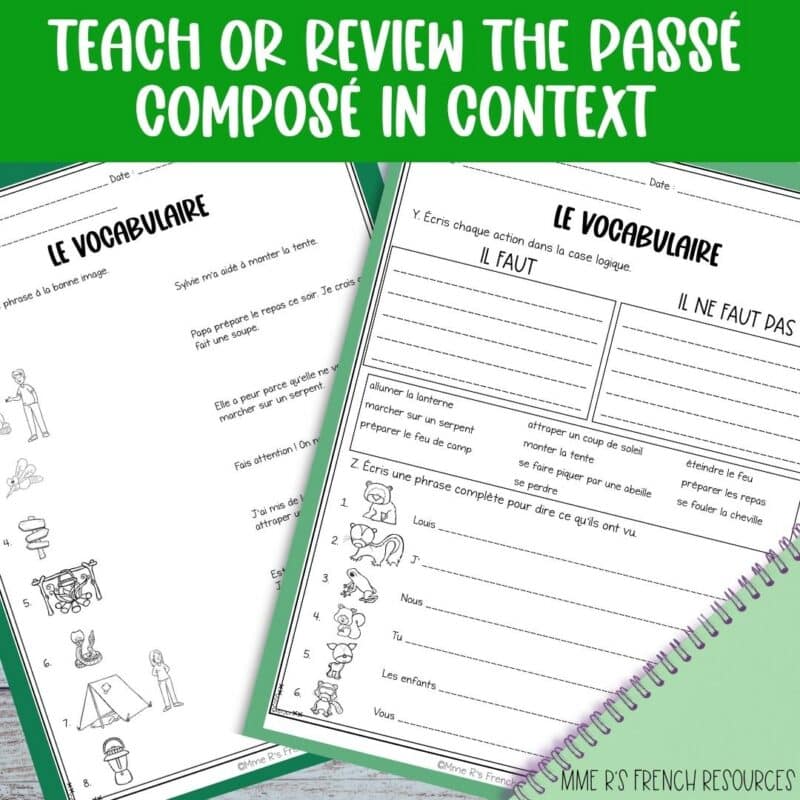
Students practice the passé composé with regular and irregular verbs, avoir and être, reflexive verbs, and temporal expressions while working with vocabulary related to camping and outdoor activities.
The resource includes tons of no-prep activities, including vocabulary practice, speaking and writing activities, games, quizzes, and review activities. It’s especially useful if you want students to practice the past tense in context rather than completing another isolated conjugation worksheet!
Find it now: French Passé Composé Activities | Camping Vocabulary, Speaking & Writing
7. Have Students Interview Each Other
Pair students up and give them a list of passé composé questions.
After the interview, students introduce their partner to the class.
For example:
Qu’est-ce que tu as fait samedi ?
Où es-tu allé(e) le week-end dernier ?
Qu’est-ce que tu as mangé ?
Avec qui est-ce que tu es sorti(e) ?
Est-ce que tu as vu un film pendant le week-end ?
Est-ce que tu as fait quelque chose de spécial ?
Qu’est-ce que tu as porté hier ?
This gives students practice with both asking and answering questions—and it naturally creates repetition without requiring students to complete the same type of exercise twenty times.
Find French conversation prompts for the passé composé here.
8. Use “Find Someone Who…”
As a class, brainstorm a list of verbs that students could use to describe what they have recently done. You can write them on your board as infinitives or like this:
Trouvez quelqu’un qui…
- a mangé au restaurant
- a regardé un film
- a fait du sport
- est allé(e) au cinéma
- a joué à un jeu vidéo
- a lu un livre
- a voyagé
- a cuisiné
Students walk around the room asking classmates questions to find someone who matches each statement.
Est-ce que tu as fait du sport ce week-end?
Oui, j’ai joué au basket avec mon frère!
This is an easy way to get students moving while giving them a lot of repetition with the passé composé.
9. Don’t Forget the Writing
Speaking activities are important, but students also need opportunities to produce the passé composé in writing.
Try short, manageable writing tasks rather than always assigning a long paragraph.
For example:
Write five things you did last weekend.
Then add a challenge:
Add two details to each sentence.
Instead of:
J’ai regardé un film.
Students write:
Samedi soir, j’ai regardé un film comique avec ma sœur.
This helps students move from simply forming the tense to communicating complete ideas in French.
Check out this French writing blog post to learn how I teach students to write longer, more detailed sentences.
10. Mix Grammar Practice With Communication
Ultimately, students need both kinds of practice.
They need activities where they can focus on:
- choosing the correct auxiliary verb
- forming the past participle
- using irregular past participles
- forming reflexive verbs
But they also need opportunities to use the passé composé to say something meaningful.
That’s why I like combining traditional grammar practice with games, speaking activities, writing, stories, interviews, and thematic vocabulary.
When students repeatedly use the passé composé in different contexts, the grammar becomes more than a formula they have memorized—it becomes something they can actually use to communicate.
More French Passé Composé Resources
If you’re looking for more ways to practice the passé composé, I have a lot of French grammar resources and speaking activities designed to give students repeated practice with the past tense.
And if you’re teaching a camping or outdoor vocabulary unit, my French Passé Composé Activities | Camping Vocabulary, Speaking & Writing resource combines grammar practice with a fun, thematic context.
For additional opportunities to expose students to French in context, TV5MONDE offers free French-learning activities based on authentic video.
Keep reading: How to teach the passé composé